I spent seven years at Auto Trader. For most of it I ran a floor of around a hundred sales and service people, and I got to sales director level. But what shaped me wasn't the targets or the day-to-day challenges. It's standing in front of the CEO and the commercial finance team every month having my numbers taken apart.
They weren't unkind about it. They were just relentless. Where has this come from. Why is that assumption reasonable. What happens if you're wrong. I hated it at the time. It's the most useful thing that ever happened to me professionally.
Because what I was really watching was an industry being rebuilt. Auto Trader had been a magazine. By the time I left I had seen first hand what an entire transformation can do for an industry. Seven thousand customers. Print to digital. And it still took years, because digital transformation in a traditional industry is never about the technology. It's about trust.
That lesson is the reason Sponsorfy exists, and it's the reason I'm building it the way I am.
01The first attempt
In the first lockdown back in 2020, I furloughed my entire team. One day I was in an office with hundreds of people. The next I had a spare room and a lot of time. I'd been carrying an idea for a while: the Auto Trader of football sponsorship. Somewhere a club could list what it had to sell, and a business could see it, understand it and act on it. Nobody had built it. I couldn't work out why.
So I taught myself WordPress. I am not a developer. What I built was, to be generous, basic. A marketplace held together with hope. I launched it in August 2020 expecting very little.
In the first three months it did over ten thousand unique visits. That number changed everything for me, and not because it was big. Because of what it proved. Nobody had asked for this. There was no marketing budget. The demand was simply sitting there, unserved, waiting for somewhere to go.
That led to investment from a tech house in South Dublin, and four years of my life. At its peak we had twelve developers working on it. And after four years, we still hadn't taken a full platform to market. The CEO of the parent business had a vision for a different direction. Mine hadn't changed. When visions don't align, the honest thing is to say so and go your separate ways. Four years. No product in market. On paper, a failure.
02What four years actually bought
Hundreds of conversations with rights holders. Premier League down to grassroots. Chairmen, commercial directors, volunteers, owners. And the same story every single time, told in slightly different words.
The very first sponsorship deal I ever did was for a semi-professional club. Getting one logo onto one perimeter board took four weeks. Not because the sponsor was hesitant - they'd said yes almost immediately. It took four weeks because the chairman was also the groundsman, and the manager's manager, and the person who chased the sponsors. There was no system. There was just him, and there were only so many hours.
Move up the pyramid and it doesn't get better, it just gets more expensive. A well-run club I sat with recently keeps its commercial data across several spreadsheets, maintained diligently by one person. It is, in the fullest sense, their version of the truth. It also isn't shareable, isn't collaborative, and can't be defended in a board meeting. And at the top, a Premier League club runs a multi-million pound commercial estate with a team of four or five people. There simply aren't enough of them to get round every customer they already have.
Football doesn't have a demand problem. It has an infrastructure problem.
03What made me come back
Three things. The first was an in-person meeting with Rick Parry, chairman of the EFL. I was supposed to get fifteen minutes and got forty-five. The biggest thing the EFL is focused on is how to help all clubs operate more sustainably, and we agreed that this can be supported with access to infrastructure and technology. Not just more money coming in from the top. Better systems underneath.
The second was a meeting with Noel Mooney, CEO of the Football Association of Wales. One thing Noel said has stuck with me since:
If you can deliver this level of infrastructure and make it easy for clubs to use, then you ultimately have the potential to position as a commercial sustainability partner to us here within the Football Association of Wales.
Two governing bodies, in two separate rooms, describing the same gap. Not a marketing problem. Not a money problem. An infrastructure problem.
The third was smaller and, honestly, more persuasive. About a year ago I built a prototype, purely to test whether the market was still there. One semi-professional club used it. They embedded QR codes and shared some links. They generated just over two thousand pounds of new sponsorship in four weeks. One club. Four weeks. No sales team, no advertising spend, no clever campaign. They just made what they had visible, and asked.
04Finding James, building the team
I could see exactly what needed building. I couldn't build it. That's not false modesty. I know marketplaces. What I am not is an engineer, and the four years before this had taught me the hard way what happens when the technical vision and the commercial vision aren't the same vision.
James Ansell is a co-founder in the truest sense. Twenty years in marketplace development, a genuine leader in AI infrastructure and one of the brightest minds I have ever met. He has built the payment gateway and the AI layer that Sponsorfy runs on. When I describe what a commercial manager needs at eight o'clock on a Tuesday evening after their day job, he doesn't hear a feature request. He hears a system.
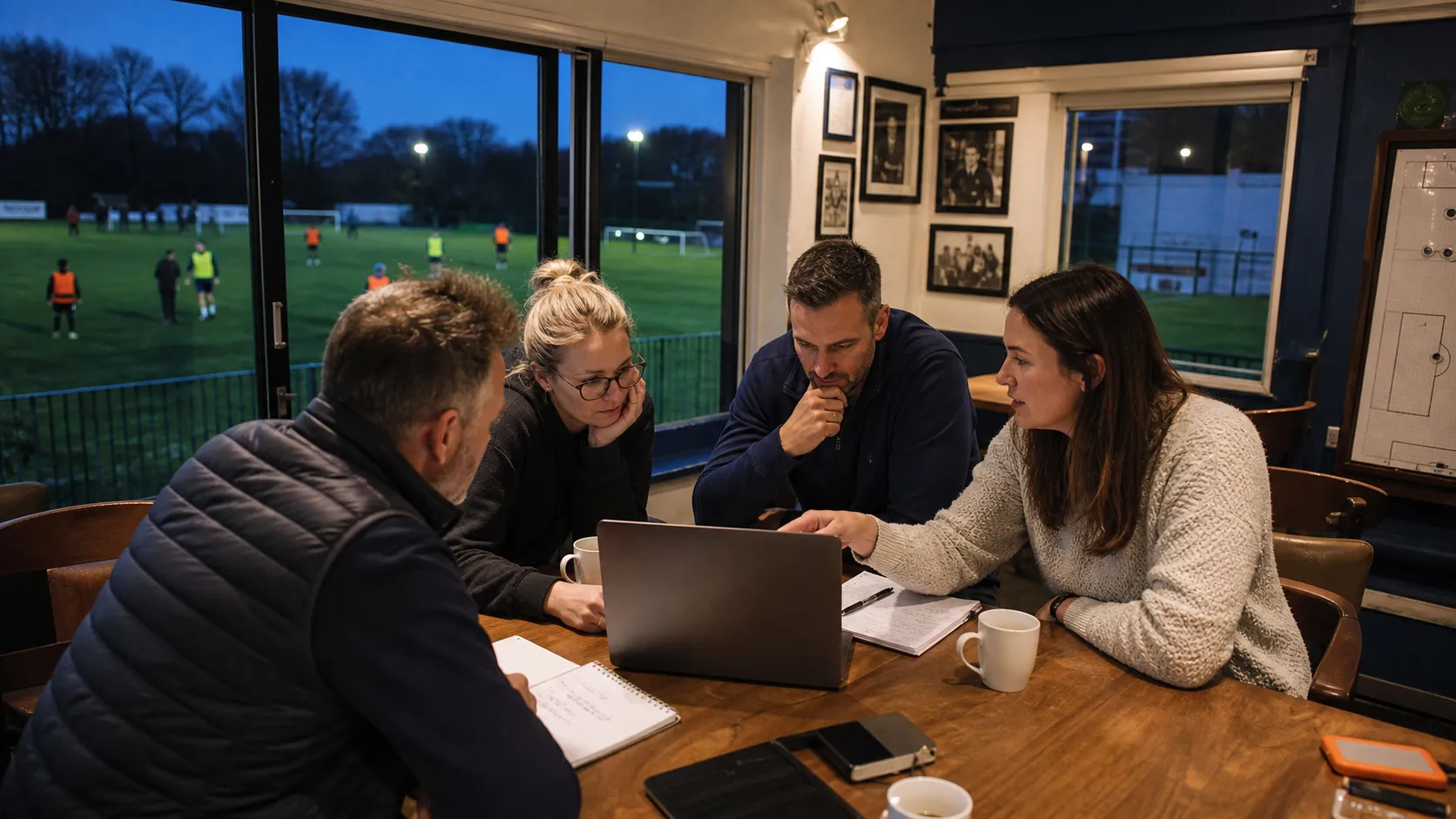
A platform is not a business. People are. Matthew Jarvis, former England international, leads as our Head of Football Strategy - when he walks into a club he is treated as a peer, because he is one. James Skivington, Corporate Partner at Browne Jacobson, is our Chair and legal adviser - he challenges me, and introduces me to people who challenge me harder. Felicity Bartlett runs operations - anyone who has scaled something knows the person who holds the operational detail together is not support. They're structural.
What we've produced is a technology asset worth around half a million pounds to replicate, built, live and owned. Every penny funded personally, with no external capital. We're not asking anyone to fund a build. The build is done.
05How we're building it
Our customers come first, and free means free. Sponsorfy costs a club nothing. No setup fee, no monthly charge, no per-user licence. We earn eight per cent when a transaction completes, and nothing at all if it doesn't. A County FA cannot roll a paid product out to two thousand volunteer-run clubs. It can absolutely tell them about a free one.
Trust is earned slowly, and it's earned by being useful first. At Auto Trader roughly twenty per cent of customers adopted anything new immediately, sixty per cent waited to be convinced, and twenty per cent never moved. I expect precisely the same here, and I'm planning for it.
We raise the bar for our industry, not just for ourselves. Goodwill shouldn't have to compensate for a lack of infrastructure. Ship, listen, fix, ship again. Every feature in Sponsorfy today came from a conversation with someone who operates in football. Not from a whiteboard.
As of today, Rochdale AFC is signed and became our first EFL club to join. We have an NDA signed with a County FA in England, conversations open with the Football Association of Wales, and active discussion with a Premier League club. The platform is built. It's live. It's owned.
06What this is really about
Fliss shared a story about her dad. He has held a Brentford season ticket for years. She'd been telling him what she was now involved with, and it prompted him to say he'd thought so many times about getting his logo onto an advertising board inside that ground, and had never known how to ask. Every week, in the stadium, wanting to give the club money, with no clear route to do it. That's not a Brentford problem. Every club in the country has a version of that person sitting in their ground right now.
The opportunity in football sponsorship isn't mostly out there somewhere, waiting to be found by a bigger sales team. It's already in the building. It just needs somewhere to go.
That's what we're building. That's why I came back.
Sponsorfy is the commercial and payments infrastructure for football clubs. Free for clubs, from the Premier League to grassroots. If you run a club and any of this sounds familiar, I'd genuinely like to hear from you.

Mark is the founder and CEO of Sponsorfy. He spent seven years at Auto Trader, reaching sales director, and has spent the last six years working with clubs from the Premier League to grassroots on the infrastructure behind football sponsorship.